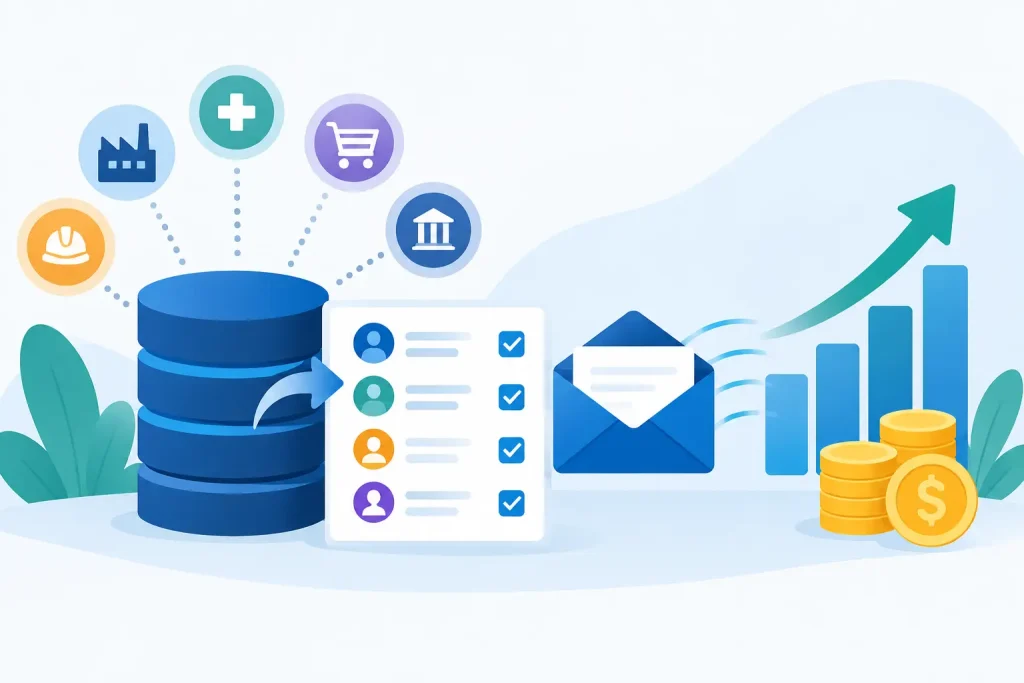
A campaign sent to 20,000 loosely relevant businesses can look productive on paper, yet deliver very little to the sales pipeline. When you select industry mailing data around the companies, decision-makers and locations most likely to buy, your budget works harder. The objective is not simply more records. It is a campaign-ready audience that gives email, telephone and direct marketing activity a realistic chance of generating enquiries.
For UK businesses buying B2B data, the difference usually comes down to detail. A broad “business database” may contain thousands of names, but if it cannot isolate the right sectors, job functions, company sizes and territories, it creates wasted spend and weak reporting. A tailored data selection gives your team a clearer commercial starting point.
Start with the commercial outcome, not the record count
Before selecting a data list, define what a good prospect looks like. This sounds obvious, but it prevents a common mistake: buying the largest possible volume because the headline price looks attractive. A larger file is rarely better if most businesses have no need, budget or authority to purchase your service.
Think about the organisations that have already produced worthwhile work. What industry are they in? Are they owner-managed firms, multi-site companies, public sector bodies or larger corporates? Do they tend to employ a certain number of staff, operate from particular regions or use a particular type of premises? These traits provide the framework for a more precise selection.
You should also decide what action you want a prospect to take. A telemarketing campaign promoting a managed IT service may need named IT managers, operations directors or managing directors, with direct telephone numbers where available. A postal campaign for commercial refurbishment may work better when targeted to facilities, estates or property contacts at organisations with suitable premises. An email campaign can require a different combination of job title, sector and company size.
The data should fit the campaign, rather than forcing the campaign to fit a generic list.
Select industry mailing data by the factors that affect buying
Industry is the starting point, not the finished brief. Standard Industry Classification categories can be useful, but they are often too broad on their own. For example, a supplier to manufacturers may want to exclude food production, focus on engineered products, or identify businesses above a particular employee threshold. A provider to schools may need to separate academies, independent schools, colleges and universities.
A dependable data supplier should be able to discuss the practical detail behind your market. That may include sector descriptions, business activity, employee bands, turnover bands, location, legal status, number of sites and named decision-maker roles. Not every field will be available or useful for every campaign. The point is to choose variables that genuinely improve relevance.
Target the people who can act
Company information tells you where to market. Contact data helps you reach the person who can progress a conversation.
For many B2B campaigns, a named contact is more valuable than a general company record. The appropriate role depends on what you sell. Finance software may need finance directors or finance managers. Recruitment services may suit HR leaders, managing directors or department heads. Office furniture, relocation and refurbishment services often need facilities, operations, estates or property contacts.
Avoid asking for every senior job title simply to increase volume. Seniority is not the same as purchasing responsibility. A managing director can be the correct contact in a 15-person company, while a facilities manager or procurement lead may be far more relevant in a larger organisation. Matching the contact role to the buying process improves both response quality and the experience of the recipient.
Use geography where it has a commercial purpose
Location matters when your service is delivered locally, when sales teams cover defined territories, or when travel time affects margin. It can also be useful for testing. A regional campaign allows you to assess offer, messaging and contact quality before committing to a wider rollout.
For national services, geography should not automatically be removed. You may still need to prioritise high-density business areas, allocate records to representatives or avoid overlap with existing clients. A properly segmented UK database can be supplied by postcode area, county, town, region or a tailored radius, depending on the available data and the nature of the campaign.
Choose data fields for the channel you will use
A contact record is only valuable when it contains the information required for your outreach plan. Buying email addresses alone may be appropriate for a focused B2B email campaign, but it will not support follow-up calling or direct post. Equally, purchasing postal data for a campaign with no physical mailing budget adds cost without helping performance.
For a multi-channel campaign, consider whether you need company name, postal address, named contact, job title, business email address, telephone number and relevant company profiling. This gives marketing and sales teams more than one route to make contact and makes campaign reporting more meaningful.
Do not assume every record will contain every field. Named contacts, direct dials and email addresses can vary by sector, job role and organisation size. Request realistic availability figures before purchasing. A transparent supplier will explain what can be supplied and where a more practical alternative may be needed.
Data quality protects campaign budget
Outdated records create more than inconvenience. They waste print, postage, calling time and sales resource. They can also damage confidence in a campaign before it has had a fair chance to perform.
Quality should therefore be assessed beyond the headline number of contacts. Ask how recently records have been checked, whether the data is maintained and tested, how duplicates are handled, and whether suppressions can be applied against your existing customer and prospect database. Suppression is particularly valuable: there is little sense paying to contact current customers, closed opportunities or businesses already being approached by your team.
A supplier with access to independent data sources can be especially useful where a market is specialised or difficult to define. Rather than accepting a standard file, you can shape the selection around the reality of your offer. AD Marketing Ltd takes this tailored approach, combining tested data supply with practical support on selection and campaign targeting.
Build GDPR and PECR considerations into the brief
Compliance should be part of the selection process, not an afterthought once the list has been bought. B2B marketing can involve different rules depending on the communication channel, the recipient type and the lawful basis being relied upon. Email, live telephone calls, postal marketing and use of personal data each require care.
When purchasing GDPR-compliant data lists in the UK, ask how the data has been sourced and maintained, what compliance information is available, and whether your intended use has been discussed. You remain responsible for using purchased data lawfully, including providing appropriate privacy information, respecting opt-outs and maintaining your own suppression processes.
There is no single compliance shortcut. A campaign to limited companies may have different practical considerations from a campaign involving sole traders, partnerships or personal email addresses. If your campaign is complex or high-volume, seek appropriate legal or compliance advice before launch. Good data supports responsible marketing, but it does not replace your organisation’s obligations.
Test a defined segment before scaling
Even an accurately selected audience may respond differently to different messages. Offer, timing, creative and follow-up all influence results. A controlled test allows you to identify what is working without committing the full budget at once.
Choose a meaningful segment, use one clear offer and agree in advance what success looks like. That might be positive call outcomes, email engagement, booked meetings, qualified enquiries or sales opportunities. Track results by sector, job title, company size and region wherever possible. The findings can then guide the next data selection instead of relying on assumptions.
This is where tailored data becomes an operational advantage. If a particular sector produces enquiries but a certain size band does not, the next order can be refined. If operations contacts respond better than managing directors, you can shift the emphasis. Better targeting is an ongoing process, not a one-off purchase.
Buy data that gives sales a reason to follow up
The best industry mailing data is not the file with the most rows. It is the data that gives your sales and marketing teams a credible reason to start a relevant conversation. Be specific about your target market, select contacts with a role in the buying decision, match the fields to your channel and protect the budget with quality and compliance checks.
A well-briefed data order creates cleaner outreach from the first send or call, while leaving room to learn and refine. That is how a purchased B2B contact database becomes more than a list – it becomes a more disciplined route to new business.