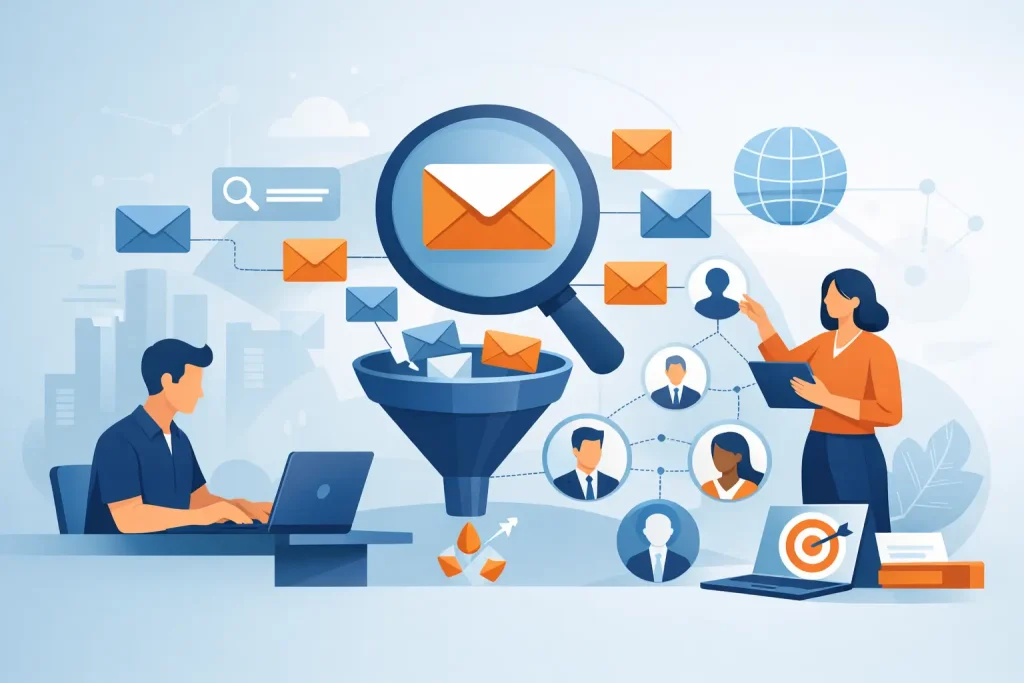
A campaign can look well planned on paper and still fail before the first message is sent. The usual reason is not the copy or the offer. It is the data. Knowing how to source company emails properly means finding relevant decision-makers, checking that the records are current, and choosing a lawful basis for the activity – not simply collecting as many addresses as possible.
For UK B2B marketers, a smaller, tightly defined contact file will usually outperform a large generic download. The right company email list gives sales and marketing teams a credible starting point for outreach, reduces wasted sends and supports a more measurable return on campaign spend.
Start with the audience, not the email address
Before sourcing records, define the companies and people most likely to buy. This sounds obvious, but it is where many campaigns lose value. A list of managing directors is not automatically useful if your offer is normally assessed by operations managers, IT leads or procurement teams.
Build the brief around practical targeting criteria: industry, location, company size, turnover where relevant, number of employees, job function, seniority and the type of organisation. A regional construction supplier may need facilities managers at multi-site businesses within a workable delivery area. A software provider may need finance directors at firms with 20 to 250 employees. These are very different data requirements.
Be equally clear about exclusions. Existing customers, competitors, sole traders, unsuitable business sizes and sectors with long buying cycles can all consume budget without creating meaningful opportunity. A good data brief tells a supplier who not to include as well as who to select.
The main ways to source company emails
There are several routes to business email data, but they do not offer the same scale, accuracy or compliance support. The sensible choice depends on whether you need a handful of strategic accounts, an ongoing prospecting process, or a campaign-ready volume of contacts.
Build your own prospect list
Sales teams often start with public company websites, trade directories, event exhibitor lists, professional networks and company announcements. This can work well for account-based activity where each prospect has a high potential value. It allows a researcher to understand the organisation before making contact and to identify relevant triggers such as expansion, relocation or a leadership appointment.
The trade-off is time. Public information can be incomplete, generic inboxes may not reach the right person, and manual research is expensive when a campaign needs thousands of contacts. It also creates a maintenance issue: a record that was correct when researched may be wrong a few months later.
Use this method for selective, high-value accounts rather than as the default answer to every lead generation challenge.
Generate inbound enquiries and capture consent
Website forms, downloadable resources, webinars, events and quotation requests can create a valuable permission-based database. These contacts have shown some degree of interest, which can make them highly responsive when follow-up is relevant and timely.
However, inbound activity takes investment and does not replace outbound prospecting when a business needs to enter a new sector or build pipeline quickly. Consent must also be captured clearly, recorded properly and managed over time. A form submission is not a reason to send unrelated promotional emails indefinitely.
Purchase a tailored B2B email database
For most scalable outbound campaigns, purchasing a tailored, verified B2B contact database is the practical route. It provides speed without forcing your team to choose between poor targeting and weeks of manual data collection.
The key word is tailored. Avoid buying a broad file merely because it contains a large number of records at an attractive price. A list should be selected around the exact profile of company and contact required for the campaign. Depending on the brief, useful fields may include company name, postal address, business sector, employee band, named contact, job title, direct telephone number and business email address.
A specialist supplier should be able to discuss the selection in commercial terms. Which job titles influence the purchase? Is national coverage necessary? Does the offer suit independent firms, larger organisations or both? Is a named decision-maker essential, or will a functional contact point support the campaign? These questions protect your budget and improve the relevance of the outreach.
How to assess the quality of a company email list
Data quality is not a vague promise. Ask direct questions before committing to a purchase. How recently are records checked? How are email addresses validated? Can the file be filtered by job function and seniority? Is the data supplied for your exclusive campaign use, and what is the replacement policy for invalid records?
Freshness matters because businesses change constantly. People leave, companies move, roles are renamed and email systems change. No commercial database can promise that every address will remain valid forever, but a reputable provider should have an active process for testing, updating and removing records.
Check whether the supplier understands the difference between company information and contact information. A company name and switchboard number may be useful for postal or telemarketing activity, but they are not enough for a targeted email campaign. If email is the channel, make sure the file contains the appropriate email fields and that the target role is meaningful.
It is also worth asking for a count before you buy. A tailored count confirms how many records exist within your exact criteria and prevents the common problem of paying for a large file that only partly fits your market.
GDPR, PECR and responsible B2B outreach
Sourcing company emails is not just a data exercise. UK marketers must consider the UK GDPR, the Privacy and Electronic Communications Regulations (PECR), and the nature of each contact. A named work email address can be personal data, even when it is used for business purposes.
Business-to-business email marketing may be possible under legitimate interests in appropriate circumstances, but that is not a blanket permission to contact anyone. You need a clear and documented rationale, a relevant message, transparent privacy information and a simple way for recipients to opt out. Suppression requests must be acted on promptly and retained so that people are not contacted again by mistake.
Sole traders and certain partnerships need particular care because the rules for electronic marketing can differ from those applying to limited companies. This is one reason generic, poorly documented email lists create avoidable risk. If your campaign is complex, involves sensitive sectors or uses multiple channels, obtain appropriate legal and compliance advice before launch.
A responsible data supplier can support your due diligence by explaining how data has been sourced, maintained and made available for marketing purposes. “GDPR compliant” should never be treated as a label that removes the marketer’s own responsibilities. The organisation sending the email still needs to ensure its campaign is fair, relevant and properly managed.
Prepare the data before the first send
Even a well-selected list needs campaign preparation. Remove existing customers and anyone who has previously opted out. Match the purchased file against your CRM to avoid duplicate contact and to identify accounts that are already being handled by sales.
Then segment the data. At a minimum, separate audiences by sector, company size or job role where the proposition differs. An email to a finance director should not read like one written for a facilities manager. Relevance improves reply rates, but it also reduces complaints because the recipient can see why the message was sent to them.
Start with a controlled test rather than mailing the entire file at once. Test subject lines, offers, landing page messages and segments in manageable batches. Monitor delivery, bounces, opens where measurable, clicks, replies, objections and opt-outs. The most useful metric is not the largest open rate. It is the number of qualified conversations and sales opportunities created per pound spent.
Choosing a data partner for repeatable results
A one-off email file may fill an immediate gap, but the strongest results usually come from treating data as an ongoing marketing asset. Your targeting will improve as you learn which sectors respond, which titles convert and where your sales team sees real opportunity.
Look for a supplier that will refine the selection with you rather than push a standard database. Experience across B2B company data, public sector records, education contacts and specialist business triggers can be valuable when your campaign evolves beyond one audience or channel. The ability to combine email data with telephone and postal details also gives sales teams sensible follow-up options.
AD Marketing Ltd works with businesses that need tailored UK marketing data rather than anonymous bulk records. A clear brief, a current count and an honest conversation about your campaign objectives will produce a more useful file than any off-the-shelf list.
When you source company emails with care, every record has a job to do: put a relevant offer in front of a person who can act on it. Start with the market you genuinely want to win, and let the data support a campaign your team can follow through.