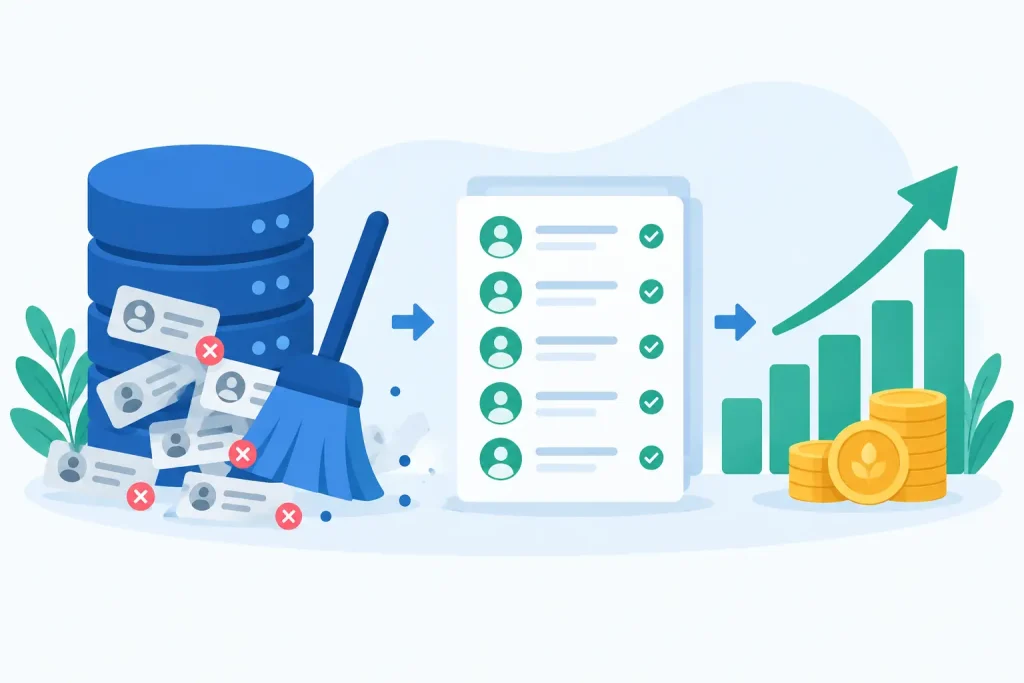
A sales campaign can fail before the first email is sent or the first call is made. A database full of departed employees, duplicated contacts and businesses outside your target market creates wasted cost at every stage. Database cleansing for lead generation is the practical work of removing that waste so your team can concentrate on organisations and decision-makers worth contacting.
For businesses buying B2B data, cleansing is not a cosmetic exercise. It determines whether a campaign reaches the right job title, whether calling time is productive and whether marketing spend produces credible opportunities. A lower volume of well-selected, current contacts will usually outperform a larger, generic file with no clear selection logic.
What database cleansing means in practice
Cleansing means checking, correcting, standardising and qualifying the records used for marketing. It can apply to your existing CRM, a historic prospect list or a newly acquired B2B contact database. The aim is not simply to reduce record numbers. The aim is to make the remaining records more useful for a defined campaign.
A proper review looks at the basics first: company name, trading status, address, telephone number, named contact, job title and email address. It then considers whether the organisation matches your ideal customer profile. A valid company record is not automatically a valid prospect. If you sell facilities services to multi-site organisations, a sole trader or a business with no relevant premises may be accurate but still unsuitable.
Data fields also need to work consistently. One record may say “Marketing Director”, another “Director of Marketing”, and another may contain only “Marketing”. Standardising titles makes segmentation possible. The same applies to employee bands, industry descriptions, turnover ranges and location data. Without consistency, filters can exclude ideal prospects or include the wrong businesses.
Why poor data quietly damages campaign results
Poor-quality records rarely show up as one dramatic problem. They create a series of smaller losses: email bounces, unanswered calls, duplicate conversations, returned post and reports that do not reflect the true performance of the offer. Over time, those losses make a viable campaign appear ineffective.
Outdated contacts are particularly costly in B2B marketing. People change roles, companies merge, offices move and buying responsibility shifts. A named contact can be valuable, but only when the name, role and organisation have been checked with sufficient care for the campaign channel.
There is also a reputational issue. Repeatedly approaching irrelevant businesses or contacting an employee who left months ago suggests that the sender has not done their homework. In competitive sectors, that can make it harder for sales teams to start a useful conversation.
For email activity, poor data can affect more than one campaign. High bounce rates and weak engagement can undermine sending performance over time. For telemarketing, a stale file means agents spend paid calling hours navigating switchboards, wrong numbers and unsuitable companies. For direct mail, inaccurate addresses create immediate print and postage waste. Cleansing protects budget because it reduces avoidable activity before launch.
Database cleansing for lead generation starts with the audience
The best cleaning criteria come from the campaign brief, not from a generic data checklist. Before updating or purchasing records, define who you need to reach and why. Consider the industry sectors, company size, UK regions, employee range, turnover, site count and job functions that are most likely to buy.
Be equally clear about exclusions. A managed IT provider may wish to target organisations with 20 to 250 employees but exclude competitors, public bodies, very small firms and current customers. A training company may need HR, learning and development, or operations contacts rather than every director in a business. Clear inclusion and exclusion rules prevent the database becoming broad simply for the sake of volume.
The right contact level depends on the proposition. Senior decision-makers are appropriate for strategic, high-value services. Day-to-day users or managers may be more relevant for operational products. In many cases, buying decisions involve more than one person, so a carefully selected set of contacts per company can be more effective than relying on a single name.
The checks that make a list campaign-ready
A campaign-ready database should be reviewed against several distinct quality checks:
- Duplicate records should be identified across company names, domains, telephone numbers and individual contacts, so teams do not make repeated approaches.
- Businesses should be checked for current trading status and matched against the location, sector and size criteria in the campaign brief.
- Contacts and job titles should be assessed for relevance, particularly where named decision-makers are required for email or telephone outreach.
- Email addresses, phone numbers and postal details should be validated where appropriate to the intended channel.
- Fields should be standardised so reporting, segmentation and CRM imports remain accurate.
- Suppression records, opt-outs and existing customers should be removed or flagged before activity begins.
Not every campaign requires every available field. A postal campaign may prioritise accurate premises addresses and business size, while a telemarketing project may depend on switchboard numbers, direct dials and contact seniority. Paying for data that will not be used is unnecessary. Equally, buying a low-cost list without the fields needed to target properly often proves expensive once campaign waste is measured.
Clean your CRM, buy fresh data, or combine both?
The right approach depends on the condition of your existing records and the scale of your growth plans. If you have a strong CRM containing recent enquiries, customers and historic prospects, cleansing and re-segmenting that file may reveal immediate opportunities. It can help sales teams prioritise dormant accounts, identify incomplete records and stop duplicate activity.
However, internal data alone may not be enough when you need to enter a new sector, region or company-size bracket. In that situation, a tailored external data list can add the specific businesses and decision-makers your CRM does not contain. The value is in the selection. A business list built around your target profile is more useful than a large, unfiltered export of companies.
Often, the strongest option is to combine the two. Clean the internal CRM first, apply customer and prospect suppressions, then add fresh contacts that match an agreed brief. This gives marketing teams a larger addressable market without contacting existing customers as though they were cold prospects.
AD Marketing Ltd works with clients in this way, supplying tailored business data while helping define the selections most likely to support the campaign objective. That practical input matters when a vague brief could otherwise lead to an expensive, poorly targeted purchase.
Data quality and GDPR need to sit together
A clean database is not automatically GDPR compliant, and a compliant approach does not remove the need for accurate targeting. Both need attention. UK businesses using personal data for B2B marketing should consider their lawful basis, provide appropriate privacy information, respect objections and maintain suppression processes. The requirements can vary according to the channel, the data held and the nature of the activity.
For email marketing in particular, businesses should make sure their planned outreach is suitable for the type of contact and meets applicable privacy and electronic marketing rules. For telephone and postal campaigns, screening and preference requirements must also be considered. Seeking specialist legal advice is sensible where there is uncertainty.
When purchasing GDPR compliant data lists in the UK, ask direct questions about sourcing, verification, update processes, selection criteria and how opt-outs are handled. A supplier should be able to discuss the data in practical terms rather than relying on vague assurances. Freshness, traceability and relevance are commercial requirements as well as compliance considerations.
Measure the improvement, not just the volume
Cleansing should produce evidence, not merely a tidier spreadsheet. Compare campaign performance before and after data improvements using measures relevant to the channel: delivery and bounce rates for email, connection and conversation rates for calling, response rates for post, and qualified enquiries or appointments across all activity.
Do not judge data solely by open rates or call volumes. A smaller list can generate fewer initial interactions but more qualified opportunities if the audience is closely aligned with your offer. The better measure is cost per meaningful conversation, enquiry, appointment or sale.
Keep a feedback loop between marketing, sales and the data owner. When a caller finds a record is wrong, a contact says they are not responsible, or a sector consistently underperforms, that information should refine the next selection. Database cleansing is most effective when it becomes an ongoing campaign discipline rather than a one-off rescue job.
Before committing budget to your next outreach programme, define the organisations you genuinely want to win, the people who influence the purchase and the records you must exclude. A carefully cleansed and tailored database gives every email, call and mailing a better reason to exist.