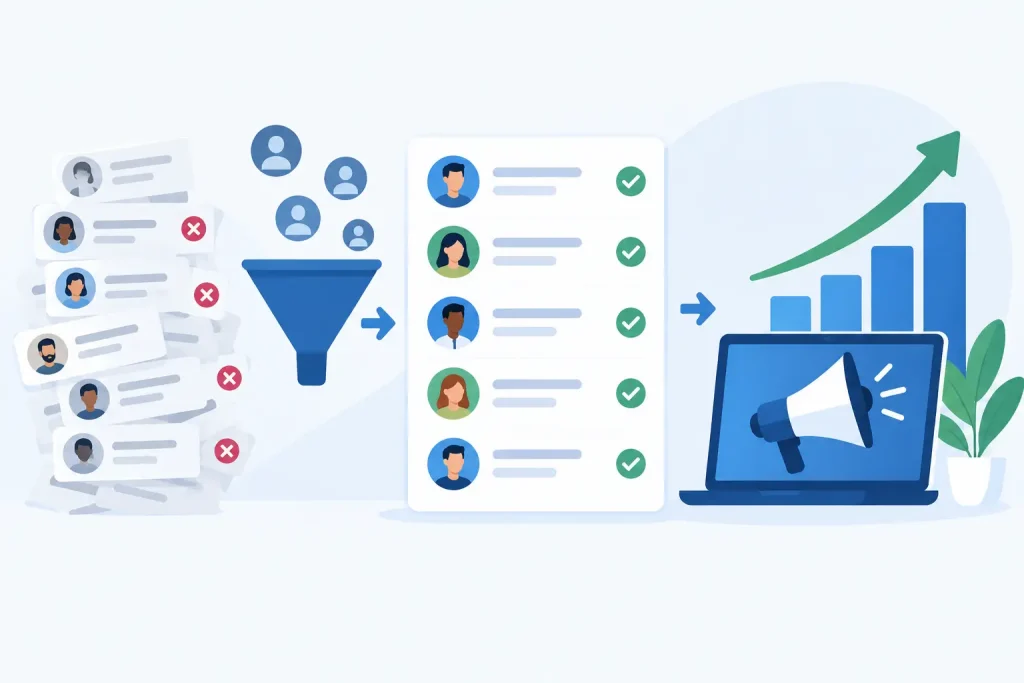
A poor database can make a sound campaign look like a failure. If emails bounce, telephone numbers reach the wrong department, or contacts have no authority to buy, the issue is rarely the message alone. B2B list quality determines whether your budget reaches relevant businesses and named decision-makers or disappears into wasted activity.
For organisations buying data for email, telemarketing, direct mail or integrated outreach, record volume is not the main measure of value. The useful question is whether the data gives your team a credible route to the right people, in the right organisations, at the right time. That requires accurate, current and carefully selected information – not a generic file sold on numbers alone.
What B2B list quality means in practice
A quality B2B list is fit for a defined campaign. It contains businesses that match the market you want to reach, alongside the contact details and selection criteria needed to approach them appropriately. Accuracy matters, but accuracy without relevance is still wasteful.
For example, a commercial cleaning supplier may need facilities managers or operations directors at multi-site firms. A software provider selling to finance teams may need finance directors, heads of finance or procurement contacts within companies of a particular size. Both campaigns can use valid business records, yet each needs a very different audience.
Good data selection brings together several elements: company name, address, telephone number, sector, employee size, turnover where available, job title, named contact, email address and other campaign-relevant indicators. The right combination depends on how you intend to make contact. A telemarketing campaign may prioritise direct dials and senior job functions, while a postal campaign may place greater weight on verified site addresses and business location.
Freshness is equally important. Companies move premises, restructure, change suppliers and appoint new people. Contacts change roles frequently, particularly in sales, marketing, HR and operational functions. A provider should have a clear process for testing, updating and suppressing records rather than treating a database as a static asset.
The commercial cost of low-quality data
Cheap records often become expensive once a campaign starts. A list with weak targeting creates extra work for sales staff, higher email bounce rates, lower engagement and poor call productivity. It can also distort the results of a campaign, leading a business to abandon a viable proposition because it was presented to the wrong audience.
Consider a team making 1,000 calls. If a substantial proportion reach irrelevant job roles, disconnected numbers or businesses outside the intended profile, the loss is more than the cost of the list. It includes employee time, management time and missed opportunities to speak with viable prospects. The same principle applies to email activity: poor addresses damage deliverability and make it harder to judge whether your offer is actually resonating.
There is a trade-off to consider. The narrowest possible selection may produce a smaller universe of prospects, while broader criteria create more volume but less focus. Neither is automatically right. The best approach is to match the data scope to the campaign objective, sales capacity and expected customer value. For a high-value service, a smaller list of carefully profiled organisations is often the stronger commercial decision.
How to assess B2B list quality before you buy
Do not rely on a supplier’s record count or a vague claim that data is “up to date”. Ask practical questions about how the list will be built and what fields it includes. A specialist supplier should be able to discuss your market, recommend sensible selection criteria and explain what is realistically available.
Start with your ideal prospect
Before requesting a quote, define the organisations most likely to buy. Useful criteria may include industry, location, number of employees, turnover band, company type, number of sites and ownership structure. Then identify the people involved in the decision – whether that is an owner, managing director, procurement lead, IT manager, facilities manager or marketing director.
Be specific without becoming unnecessarily restrictive. “UK businesses” is not a targeting brief. “Independent hospitality groups with 20 to 200 employees, operating in England and with a named operations or purchasing contact” gives a data supplier something commercially useful to work with.
Check the contact fields against the campaign channel
A named contact is valuable when the message depends on relevance to a job function. However, names alone do not guarantee a successful campaign. You also need the appropriate channels through which to reach that person.
For purchase email marketing lists, ask whether email addresses are supplied for the selected job titles and how email data is validated. For telemarketing, establish whether switchboard numbers, direct dials or mobile numbers are available, and avoid assuming every record will include every field. For direct marketing, confirm the postal address is a business location appropriate for the intended recipient.
A good supplier will be candid about coverage. Some sectors and job levels are easier to identify than others. Honest expectations are more useful than inflated promises.
Ask how the data is tested and maintained
Quality control should not be an afterthought. Ask how records are checked, how often key information is refreshed and what processes are used to identify duplicates, business closures and changed contact details. Where appropriate, ask whether the data has been tested in live campaign conditions.
There is no realistic database with zero change. What matters is whether the supplier actively manages that change and applies sensible validation procedures before supplying records. In-house tested data and access to independent data sources can provide a stronger basis for tailored selections than a one-size-fits-all bulk file.
Treat compliance as part of quality
GDPR compliance is not separate from data quality. If your business is buying GDPR compliant data lists in the UK, you need to understand the lawful basis and the responsibilities that remain with your organisation when using the data. The list supplier should be able to provide clear information about data sourcing, intended use and compliance considerations.
Your own campaign also needs to be appropriate. This includes relevant messaging, transparent identity, a clear opt-out process where required and internal procedures for handling suppression requests. Buying data does not remove the need for responsible marketing practice. It gives you a better starting point for conducting that activity properly.
Why tailored data usually outperforms bulk databases
A large B2B contact database for sale can appear attractive because it offers immediate scale. Yet scale only helps when it reflects the businesses you can genuinely serve. A nationwide list of every company in a broad sector may be useful for market research or awareness activity, but it is unlikely to be the most efficient route to qualified enquiries.
Tailored data reduces the gap between the campaign plan and the file your team receives. Rather than forcing your sales team to sift through unsuitable records, you can select businesses by the attributes that influence buying likelihood. That may mean targeting particular regions, company sizes, trading sectors, office locations or organisational roles.
It also allows for better campaign sequencing. A business can begin with a tightly defined test selection, measure response and refine its targeting before committing further budget. This is particularly useful when entering a new market or promoting a specialist service. The results then inform the next data order, rather than leaving the team with an oversized database that cannot be used effectively.
Build quality checks into your campaign process
Even the best supplied data benefits from disciplined handling after purchase. Import records carefully, retain the original selection criteria and record outcomes by segment. If a particular job title responds well, that insight should shape future selections. If a sector generates calls but few qualified opportunities, it may need to be narrowed or removed.
Sales and marketing teams should also feed updates back into their own database. Mark businesses that are unsuitable, update changed contacts and preserve opt-outs. Over time, this creates a more useful internal asset and prevents repeated contact with companies that are clearly outside your market.
For many buyers, the right supplier is not simply the one offering the lowest cost per record. It is the one willing to understand the campaign, challenge unclear targeting and provide a dataset that sales staff can use with confidence. With three decades of experience in data-led marketing, AD Marketing Ltd focuses on tailored selections that support practical outreach rather than anonymous volume.
Before buying your next list, start with the revenue opportunity you want to create, then work backwards to the companies and decision-makers most likely to respond. That is where quality becomes measurable: fewer wasted approaches, more relevant conversations and a clearer return on every pound spent.