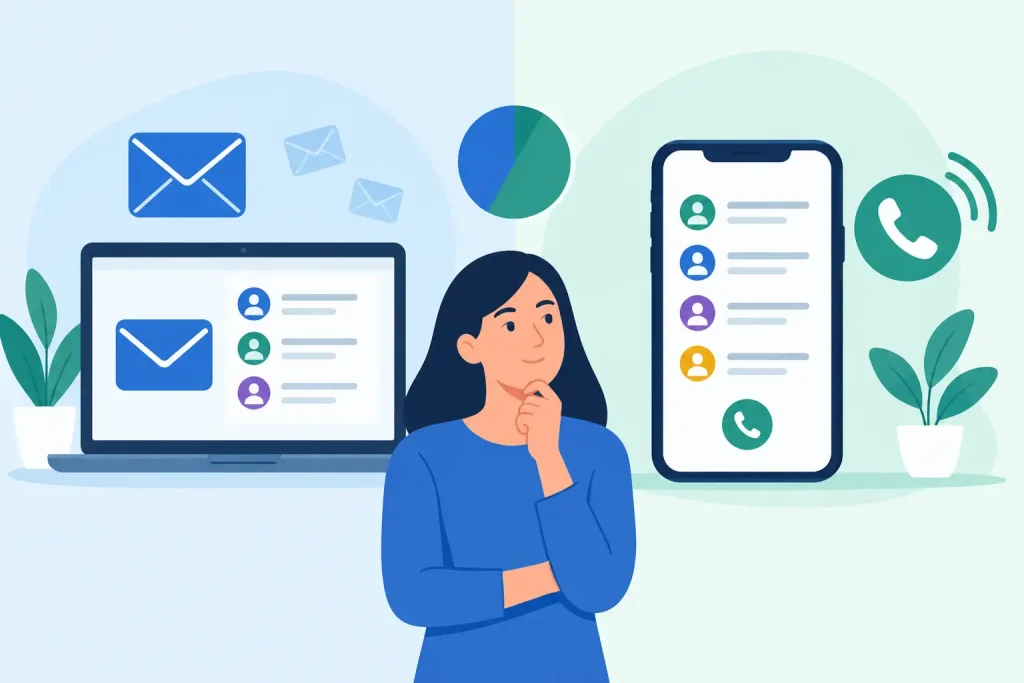
A new business database can look impressive on a spreadsheet, but campaign performance depends on what you do with each contact. The choice between email lists versus phone data affects response speed, sales resource, campaign cost and the type of conversation you can start. For UK B2B marketers under pressure to produce qualified opportunities, the right answer is rarely simply “more records”. It is the contact data that fits the offer, target audience and follow-up capacity.
Email marketing data and telephone data serve different commercial purposes. One gives you scale and repeatable communication; the other creates a direct route to a decision-maker. Used separately, each can produce results. Used as part of a properly targeted, GDPR-compliant campaign, they can make your outbound activity more measurable and more valuable.
Email Lists Versus Phone Data: The Core Difference
An email list gives you a practical way to reach a defined volume of named business contacts at relatively low cost per contact. A quality B2B email database can be selected by industry, location, company size, job function, seniority and other relevant criteria. This makes it suitable for introducing a service, promoting an event, distributing useful content or nurturing an account over time.
Phone data is built for direct engagement. A telephone number allows a trained salesperson or telemarketing team to qualify interest, handle objections and establish whether the contact has a live need. It is often the stronger option when the product or service has a higher value, requires explanation, or depends on speaking to a specific role such as a Managing Director, Facilities Manager, IT Director or Procurement Manager.
The distinction is not that email is passive and phone is proactive. Both channels need a clear proposition and accurate targeting. The difference is the level of interaction. Email lets prospects consider your message in their own time. A telephone conversation can reveal intent immediately, but it also demands more time, skill and budget.
When a B2B Email List Is the Better Purchase
Email data is usually the sensible starting point when you need market coverage without committing a large sales resource to every record. It supports controlled testing: you can trial sectors, job titles, geographic areas or company sizes, then analyse opens, clicks, replies and enquiries to refine future activity.
For example, a business selling HR software may want to reach HR Directors and People Managers across medium-sized employers. An email marketing list allows the company to introduce its proposition to a sizeable, tightly defined audience. The sales team can then prioritise people who engage, rather than attempting to call every contact from day one.
A purchase email marketing list also works well where the message is easy to understand in writing. Training providers, professional services firms, B2B suppliers and event organisers often benefit from an email that clearly sets out the offer, evidence and next step. The recipient can forward it internally, revisit it later or respond when a relevant project arises.
The trade-off is that inboxes are crowded. Even a well-targeted campaign will not create a response from every recipient. Subject lines, sender reputation, message relevance and the quality of your call to action all influence results. Email data is not a shortcut around campaign planning. It is the foundation for reaching the right businesses efficiently.
When Phone Data Produces Better Leads
Phone data earns its place when a conversation is more likely to convert than a written message. This is common with complex B2B services, high-value contracts, local business development and time-sensitive opportunities. A call can quickly establish whether a business already has a supplier, whether a contract is due for review, and who else is involved in the buying decision.
A targeted telephone list can also reduce the delay between prospecting and qualification. Rather than waiting for an email response, a capable caller can determine whether there is a fit during the first interaction. That is particularly useful for companies with an established sales team, a clear ideal customer profile and a process for handling qualified appointments.
Phone outreach is, however, more resource-intensive. A poor-quality number, the wrong job title or an irrelevant company wastes paid calling time quickly. Generic bulk lists can create the illusion of reach while undermining morale and ROI. Before purchasing phone data, define the decision-maker you need, the sectors that are commercially worthwhile and the geographical coverage your team can realistically work.
Compliance and call handling matter too. B2B telemarketing should be undertaken responsibly, with appropriate screening and processes in place. A reliable supplier can advise on data selection and help you build a dataset suited to legitimate, professional outreach rather than indiscriminate calling.
The Case for Combined Email and Telephone Data
For many campaigns, the most effective choice is not email lists versus phone data at all. It is a combined contact database containing named contacts, job titles, business email addresses and telephone numbers. This gives your marketing and sales teams a joined-up route to the same target audience.
A typical sequence might begin with an introductory email to establish awareness, followed by a call to relevant contacts a few days later. The caller can refer to the email without assuming it has been read, then introduce a specific reason for getting in touch. A second email can confirm agreed actions, provide supporting information or keep the business visible where timing is not yet right.
This approach is more effective than treating email and calls as isolated activities. Email creates familiarity and supports the sales conversation. Telephone follow-up gives your team context that email engagement figures cannot always provide. It also means promising opportunities are not lost simply because a contact did not click a link.
Combined data is especially useful for agencies, B2B service providers and businesses selling into a limited set of target accounts. If you know that a few hundred or a few thousand companies are genuinely relevant, accurate multi-channel contact data gives you more ways to develop those accounts without expanding into unsuitable markets.
Choose Data Around the Campaign, Not the Channel
The best database begins with a commercial brief. A supplier should be able to tailor records around the organisations and contacts most likely to buy, rather than offering a one-size-fits-all file. Start with the market you want to reach: industry, business type, turnover band, employee size, location and any specialist characteristics that indicate need.
Then identify the people who influence the purchase. Seniority alone is not enough. A Finance Director may control budget, but a Head of Operations may experience the problem your service solves. In larger organisations, you may need both. In smaller businesses, the owner or Managing Director may be the appropriate contact.
Your offer should shape the choice too. If you are promoting a straightforward product with a strong price point, email may deliver cost-effective volume. If you are selling consultancy, recruitment, managed services or a major capital project, direct telephone contact may justify the higher investment. If your sales cycle involves several stakeholders, buying both email and phone data gives you greater flexibility.
What to Check Before You Buy B2B Data
Data quality determines whether a campaign starts with useful conversations or wasted effort. Before you purchase a B2B contact database for sale, establish how the records have been sourced, tested and maintained. Ask what fields are available and whether the data can be selected to your exact brief rather than supplied as a broad, pre-packaged audience.
For email campaigns, check that named contacts, job titles and business email addresses are available where required. For telephone activity, confirm the type of telephone number supplied and whether contact roles are included. A number without meaningful company and job information is much harder to use productively.
GDPR compliance should be part of the buying decision, not an afterthought. Businesses using GDPR compliant data lists in the UK still need their own lawful marketing processes, clear privacy information and a way for people to opt out. A responsible data provider supports compliant use by supplying suitable business data and explaining the selection criteria, but the campaign sender remains responsible for how outreach is conducted.
Freshness matters as well. People change roles, businesses relocate, companies close and contact details expire. No data file is permanently accurate, which is why a provider’s testing procedures, update cycle and willingness to discuss quality are more valuable than vague claims about millions of records.
Make the Purchase Work Harder
Buying data should lead to an operational campaign plan, not a file that sits unused after delivery. Decide who will send the emails, who will make follow-up calls, how leads will be recorded and what counts as a qualified opportunity. Even a modestly sized, well-segmented list can outperform a much larger database when the team has a clear process.
AD Marketing Ltd works with businesses that need tailored business data rather than anonymous volume. The aim is to supply campaign-ready records that reflect the market you actually want to win, whether your priority is email outreach, telemarketing or a coordinated combination of both.
The right choice comes down to how your prospects buy and how your team sells. Choose email data when you need efficient reach and nurturing potential. Choose phone data when a direct conversation can uncover immediate need. Choose both when you want each contact to have more than one route into a well-planned sales conversation. A carefully selected database gives your next campaign a better starting point – and gives your team a more credible reason to make contact.